Direct answer
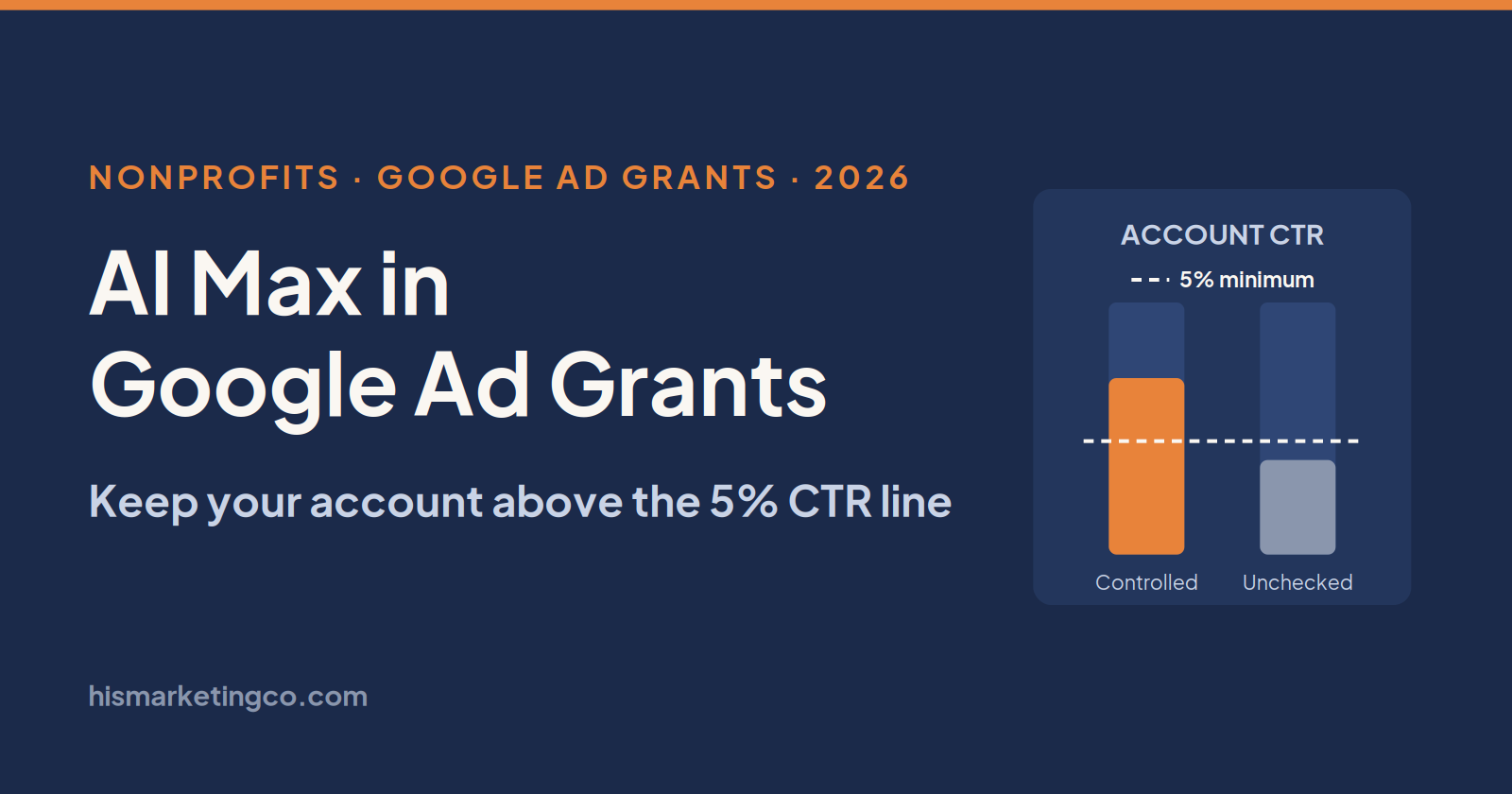
The Google Ad Grant CTR requirement is at least 5% each month at the account level for accounts that are not exclusively using Smart Campaigns. AI Max does not remove that requirement. If you use its broader search matching, monitor whether the additional impressions produce relevant clicks and meaningful nonprofit actions.
Key Takeaways
- Ad Grants accounts that are not exclusively using Smart Campaigns must maintain at least 5% monthly account-level CTR. Two consecutive months below the requirement leads to temporary deactivation (Google Ad Grants policy).
- Google scheduled the September 1 to 30, 2026 automatic migration of campaign-level broad match campaigns to AI Max with search term matching on by default, and there is no opt-out (Google Ads Developers Blog).
- Google reports advertisers who activate AI Max typically see 14% more conversions or conversion value at a similar CPA or ROAS, and 27% for campaigns built mostly on exact and phrase keywords (Google).
- Search term matching can be switched off per ad group, which is the single most useful control for a Grant account (Google Ads Help).
- AI Max matches show up as their own "AI Max" match type in the search terms report, so you can audit exactly what the expansion is buying.
- The safe rollout for nonprofits: one campaign at a time, final URL expansion off, weekly CTR checks against the 5% line.
What is AI Max in Google Ad Grants?
Still getting started? Learn how to apply for Google Ad Grants before planning your campaigns.
AI Max in Google Ad Grants is Google's AI Max for Search feature set running inside a nonprofit's grant-funded Search campaigns. Google's Nonprofits community describes it as "a relatively new feature in Search campaigns in Google Ad Grants accounts." It is not a separate campaign type like Performance Max. It is a switch that changes how your existing Search campaigns find searches, write ads, and pick landing pages.
Google launched AI Max for Search in May 2025. It bundles three features, according to Google: search term matching, text customization, and final URL expansion. Each one trades some of your control for reach, and in a Grant account that trade has a policy cost that paid advertisers never face.
"Advertisers activating AI Max in Search campaigns typically see 14% more conversions or conversion value at a similar CPA/ROAS."
Brian Burdick, Senior Director of Product Management, Google Ads, Google blog, May 2025
That number is Google's average across paying advertisers. A Grant account plays by different rules: it cannot raise budgets to chase volume, and it lives or dies by a CTR floor. If you are new to how the grant differs from paid Google Ads, start with our guide to using the Google Ad Grant for nonprofit donations.
What is the Google Ad Grant CTR requirement?
Google requires a monthly account-level CTR of at least 5%. An individual keyword or ad group does not have to reach 5% on its own. Accounts exclusively using Smart Campaigns are excepted under the account management policy.
Google's dedicated CTR guidance says accounts are not reviewed for this requirement until they are 90 days old. I recommend monitoring from launch so a new account develops relevant traffic before that review begins.
How do you calculate account CTR?
Google defines CTR as clicks divided by impressions. Multiply by 100 to express it as a percentage.
Account CTR = total account clicks ÷ total account impressions × 100
For example, 600 clicks from 10,000 impressions is a 6% CTR. Another 10,000 impressions producing only 200 clicks would bring the combined total to 800 clicks from 20,000 impressions, or 4%.
That is an illustrative calculation, not a client result. It shows why added reach can reduce account CTR even when total clicks increase. Do not take a simple average of campaign percentages. Use the combined clicks and impressions for the same reporting period.
What happens if your Google Ad Grant CTR falls below 5%?
Google's account management policy specifies temporary deactivation after two consecutive months below the threshold. One low day or week is a warning to investigate, not the two-month condition.
If the account is deactivated, follow Google's CTR recovery instructions: review the last active week, filter for enabled campaigns and keywords, pause high-impression keywords with weak CTR, and bring the filtered keyword total to at least 5%. Correct other policy issues, then request reinstatement through Google.
Pausing a keyword does not erase its historical impressions. The filtered recovery view and the historical account total answer different questions.
How should you monitor CTR when testing AI Max?
I use three views for different decisions:
| View | What I use it for |
|---|---|
| Each completed month's account total | Check the monthly threshold |
| Month-to-date account CTR | Spot a developing problem |
| Last seven active days, broken down by campaign and search term | Identify what needs attention |
Google's compliance guide recommends finding high-impression, low-CTR keywords and pausing them. Review search intent and ad relevance alongside that cleanup.
For AI Max, I also inspect the added searches and the actions visitors take afterward. A high CTR alone does not prove the campaign generates donations, volunteer registrations, or useful inquiries. My weekly review schedule is a management recommendation, not a separate Google requirement.
Why can AI Max put the Ad Grant 5% CTR rule at risk?
AI Max can introduce additional searches through broad match and keywordless matching. If those searches generate proportionally fewer clicks, they lower the combined CTR. A decline is possible, not inevitable.
Google documents AI Max as a feature suite within Search campaigns, with an AI Max match type and source columns for reviewing expanded matching. Because that traffic runs within the account's Search campaigns, include it when evaluating account performance. AI Max is not the Smart Campaigns exception.
The risk compounds with the rest of the Ad Grants compliance rules. Grant accounts must pause keywords with a Quality Score of 1 or 2, avoid disallowed single-word keywords and overly generic keywords, keep at least 2 ad groups per campaign, and record at least 1 conversion a month. AI Max does not change any of those rules; it just adds a layer of matching you have to watch.
Was your Google Ad Grant account included in the September AI Max migration?
It may have been, if a Grant campaign used campaign-level broad match or standalone automatically created assets. On September 1, 2026, Google began automatically upgrading those Search campaigns to AI Max, with a rollout scheduled through September 30. Search Engine Land confirmed advertisers cannot opt out.
Google's notice does not mention Ad Grants accounts at all, so it neither includes nor excludes them. The safe assumption: if a Grant campaign had campaign-level broad match turned on, treat it as in scope and check its settings now. For migrated campaign-level broad match campaigns, search term matching defaults to ON, while text customization and final URL expansion default to OFF. Standalone automatically created asset migrations differ: text customization defaults to ON. Existing brand lists carry over. Check the actual settings in your account.
"AI Max for Search campaigns see an average of 7% more conversions or conversion value at a similar CPA/ROAS when using the full feature suite... compared to using search term matching alone."
Brandon Ervin, Director of Product Management, Google Ads, Google blog, April 2026
Dynamic Search Ads follow later. Google plans to auto-migrate legacy DSA campaigns in February 2027 and stop new DSA ad groups at the same time, which matters because many Grant accounts still run DSA to cover their content pages.
How does each AI Max feature affect a Google Ad Grant account?
Each of the three AI Max features touches Grant compliance differently, and search term matching carries the most CTR risk. The table below maps each feature to its migration default, its Grant-specific risk, and the setting we use when a nonprofit account first turns AI Max on.
| AI Max feature | What it does | Default after campaign-level broad match migration | Grant account risk | Our starting setting |
|---|---|---|---|---|
| Search term matching | Broad match and keywordless matching to new queries | ON | High: broader queries can pull account CTR toward 5% | ON in 1 proven ad group, OFF elsewhere |
| Final URL expansion | Sends clicks to whichever page Google judges most relevant | OFF | Medium: clicks can land on pages with no conversion path | OFF until URL exclusions are set |
| Text customization | Generates headlines and descriptions from your site and ads | OFF | Low to medium: message drift on mission-sensitive topics | OFF, test later with review |
| Brand and location controls | Limit brands and locations of interest per ad group | Existing brand lists carry over | Low: these reduce risk | Use them |
The risk column is His Marketing Co's assessment for Grant accounts, not a Google rating. Google's feature descriptions come from its AI Max help documentation.
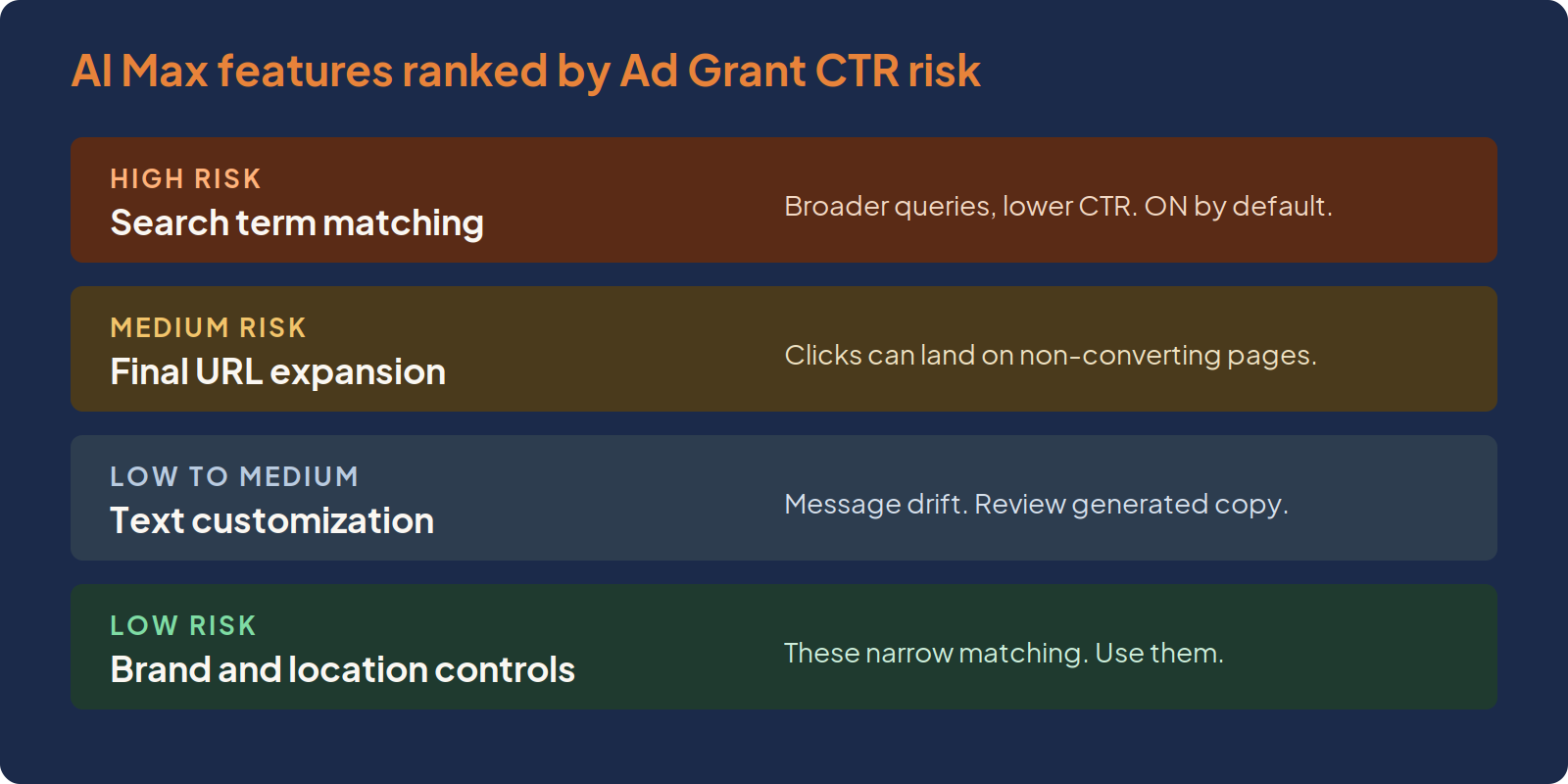
AI Max features ranked by risk to a Google Ad Grant account's 5% CTR. His Marketing Co assessment.
What should you check in your Ad Grant account this week?
Check five things after a migration or before expanding your test: which campaigns migrated, where search term matching is on, what the new matches look like, where your CTR sits, and which pages could receive clicks.
- Find migrated campaigns. Open each Search campaign's settings and look for the AI Max section. Any campaign that used campaign-level broad match should now show it.
- Turn search term matching off where it is not earned. Google says it is on by default but can be turned off in ad group settings. Leave it on only in ad groups with steady conversions and CTR well above 5%.
- Audit the "AI Max" match type. In the search terms report, filter to the AI Max match type and add negative keywords for anything off-mission. The source column shows whether a match came from broad match expansion or keywordless matching.
- Protect exact-match priorities. Google notes broad keywords are not treated as exact-match equivalents after the switch, so add copies of exact match keywords for your core terms.
- Watch CTR weekly, not monthly. Two months below 5% means deactivation. A weekly check gives you three or four chances to correct course inside each month.
If final URL expansion is on anywhere, set URL exclusions for blog archives, staff bios, and pages without a donation, volunteer, or sign-up path. Google notes pinned assets are not used when final URL expansion picks a different URL, so your carefully pinned headline may not show.
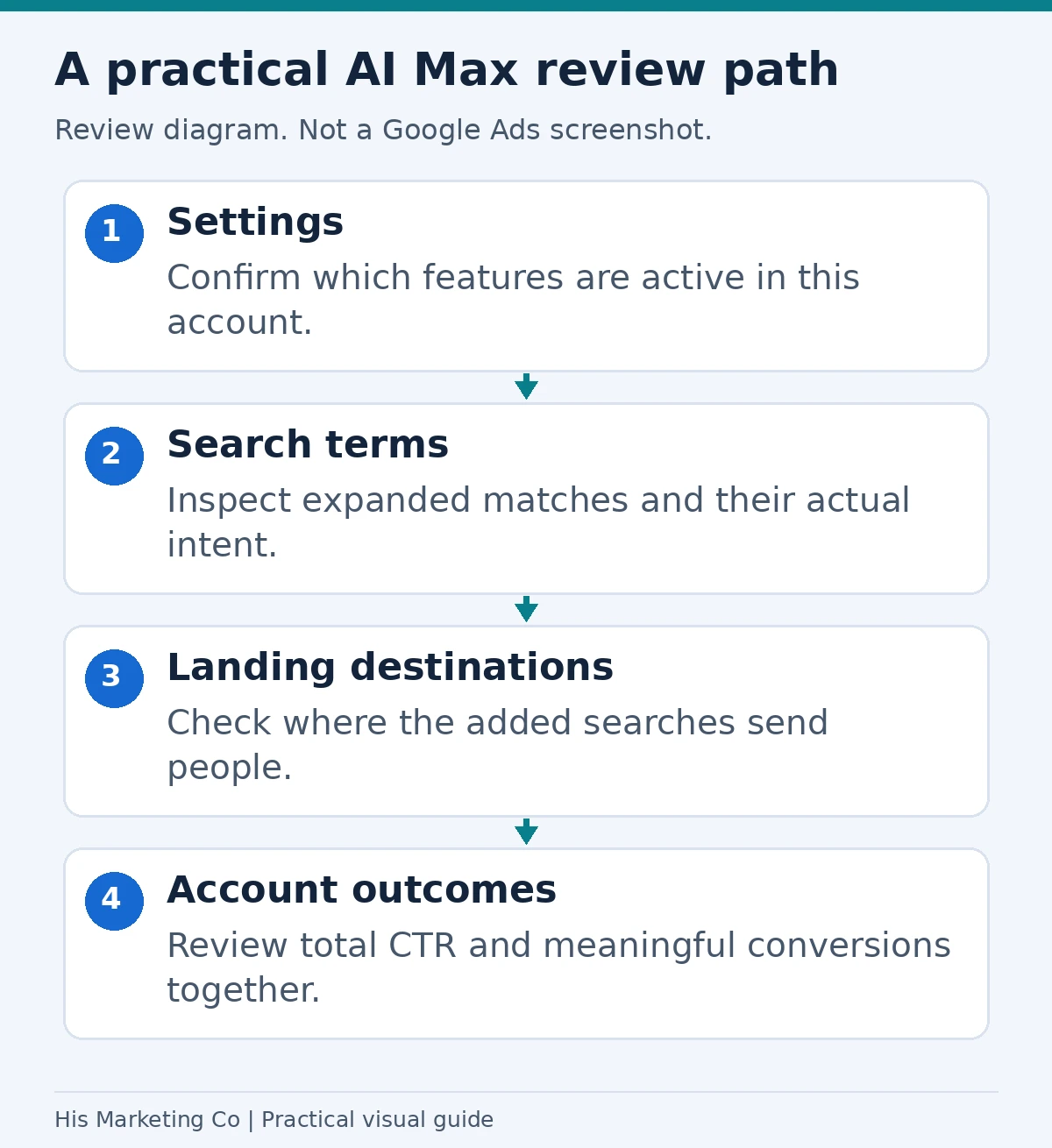
Review diagram: check active features, search terms, landing destinations, account CTR and meaningful conversions. Use your current account interface and the linked Google documentation; available controls can differ.
When does AI Max actually help a Google Ad Grant account?
AI Max may help a Grant account that already clears 5% CTR comfortably, has reliable conversion tracking, and is leaving grant dollars unspent. That is the account where extra relevant queries turn into extra donations or volunteer sign-ups instead of CTR drag.
Google's 27% figure for exact and phrase heavy campaigns is the interesting one for nonprofits, since compliant Grant accounts are usually built that way. GrantMax recommends enabling it on one high-performing campaign first and monitoring weekly, which matches how we roll it out. Accounts that are struggling to hold 5% CTR should fix keywords and ad relevance before touching AI Max at all.
Why do I start with a campaign designed for high CTR?
When I build a Google Ad Grant account, I start with a campaign designed to earn a strong click-through rate. I use tightly focused, mission-relevant searches, clear ad copy, and a landing page that matches what the person needs.
That campaign helps establish a stronger account-wide CTR. Its clicks and impressions can help offset lower-CTR campaigns while I test other ways to reach potential donors, volunteers, or people who need the nonprofit's services.
The balance depends on traffic volume. In an illustrative month, a focused campaign with 800 clicks from 8,000 impressions has a 10% CTR. A second campaign with 200 clicks from 12,000 impressions has about a 1.67% CTR. Together, they produce 1,000 clicks from 20,000 impressions, which is exactly 5%.
That example is not a client result or a target I would aim to sit on. I want room above the minimum because performance changes. A small high-CTR campaign cannot reliably offset a much larger campaign generating low-engagement impressions.
I still evaluate each campaign on relevance and meaningful outcomes. A stronger account average does not make unrelated searches useful or excuse other policy problems. I keep improving lower-CTR campaigns and reduce or pause expansion when it threatens the account's overall performance.
This is my account-management approach, not a Google requirement or a guarantee of compliance.
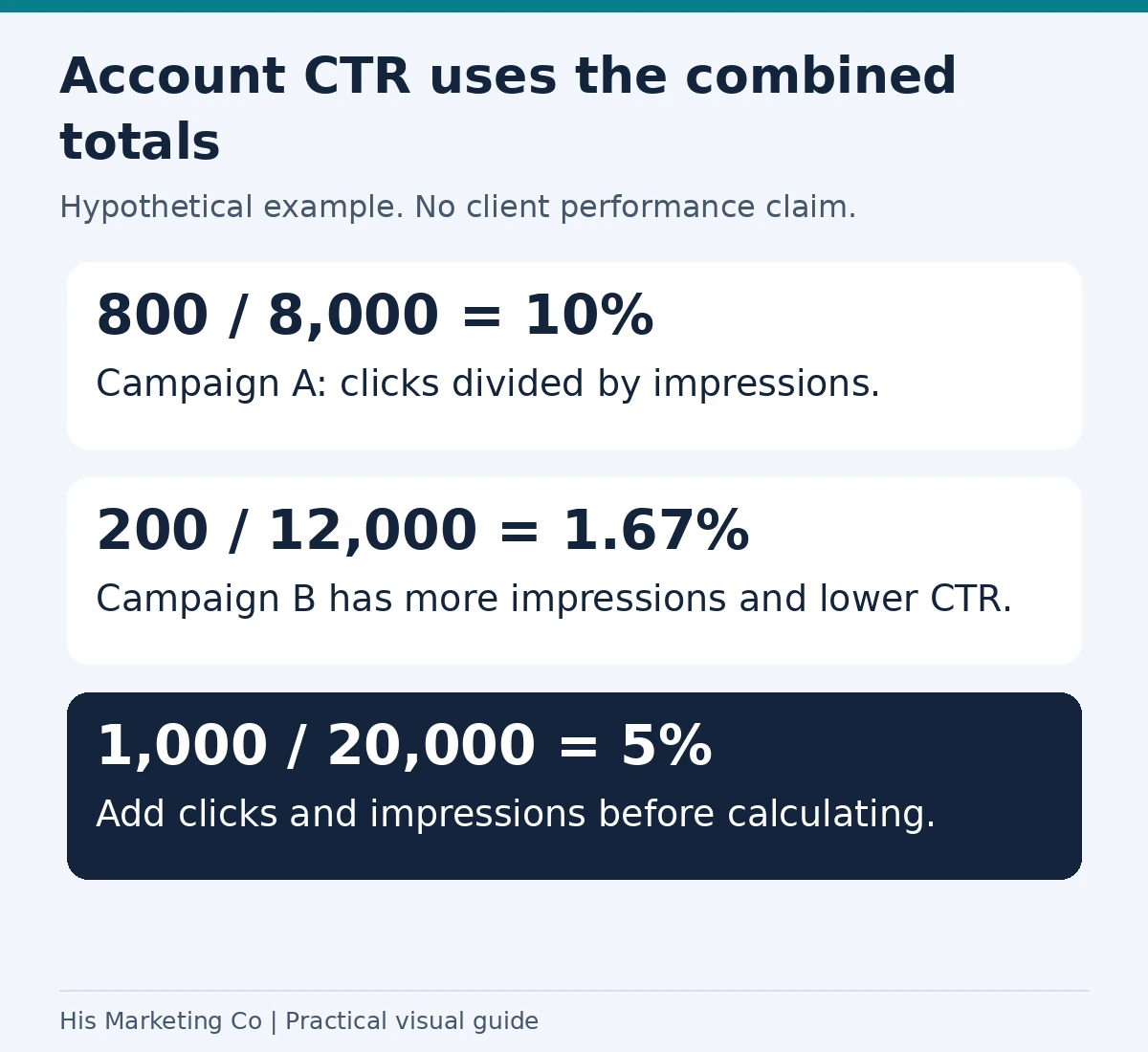
Illustrative calculation: 800 clicks from 8,000 impressions plus 200 from 12,000 gives 1,000 clicks from 20,000 impressions, or 5%. Do not average campaign percentages. This is not a recommended safety margin.
How do I manage AI Max for nonprofit Grant clients?
I establish that focused campaign first, then treat AI Max as a controlled test in the Grant accounts I manage at His Marketing Co. The process: confirm conversion tracking, enable search term matching in one proven ad group, review AI Max search terms twice a week for the first month, and expand only if account CTR holds with room to spare.
Methodology
This article is built from Google's primary documentation (the Ad Grants account management and compliance policies, the AI Max help center, and Google's May 2025 and April 2026 AI Max announcements) plus the August 2026 migration notice on the Google Ads Developers Blog. We searched Reddit and Google's Nonprofits community for practitioner reports on AI Max in Grant accounts and found no threads with usable detail, so no community anecdotes are included. The feature risk ratings are our own assessment, labeled as such.
For this October 3, 2026 update, I checked Google's account management policy, dedicated CTR requirements, CTR definition, compliance guide, and AI Max documentation. The CTR calculations above are illustrative, not client results. The high-CTR-first campaign approach describes how I manage accounts. Monthly compliance and reinstatement instructions come from Google; the monitoring routine and testing recommendations are my practical assessment.
Want the full picture of what we do for nonprofits? See our nonprofit Google Ad Grant management services, our broader Google Ads and paid media services, or more guides in Resources.
Not sure if your Grant account migrated?
Book a call and we will look at your AI Max settings, your CTR trend, and your search terms, and tell you exactly what to change before it costs you the grant.