Real Estate Meta Ads Case Study
How I Built a Meta Ads System to Turn Real Estate Leads Into Sales Opportunities
This real estate lead-generation system was built specifically around Facebook and Instagram advertising. Instead of treating a Meta lead as the finished product, I built the journey around niche targeting, low-friction lead capture, progressive qualification, CRM segmentation, and long-term nurture.

- Meta lead acquisition
- Facebook + InstagramMeta lead acquisition
- Low friction first, deeper questions second
- Two-Step QualificationLow friction first, deeper questions second
- Full acquisition process
- Target → Engage → NurtureFull acquisition process
The Challenge
Generating a Lead Was Only the First Step
Real estate lead generation has a common problem.
Generating a name, email address, and phone number is relatively easy.
Generating a prospect who fits the market, understands why they responded, and continues moving toward a real conversation is much harder.
The system needed to do more than produce Facebook leads.
It needed to:
- attract a specific type of buyer
- give that buyer a compelling reason to respond
- make the first conversion easy
- collect more useful information without hurting initial conversion
- follow up quickly
- separate stronger prospects from colder leads
- continue nurturing people who were not ready immediately
The goal was to build a path from cold online attention to an actual sales opportunity.
The Strategy
Target → Engage → Nurture
Target
Find a specific buyer opportunity
Research demand, identify a valuable real estate niche, and understand the buyer's situation and desired outcome.
Engage
Give that buyer a reason to respond
Create Meta ads and an offer specific enough to make the right prospect raise their hand.
Nurture
Turn attention into a conversation
Use qualification, CRM follow-up, segmentation, and long-term communication to move the lead toward the agent's sales process.
Target
Start With the Buyer, Not the Ad
The process started before I wrote the advertising.
I researched real market demand to understand what buyers were actively interested in within a market.
That could include:
- locations
- neighborhoods
- property types
- amenities
- home characteristics
- buyer interests
- overall search demand
The objective was to identify an opportunity with enough demand to support advertising while still being specific enough to create relevant messaging.
I then matched that opportunity with the type of client the real estate professional actually wanted to work with.
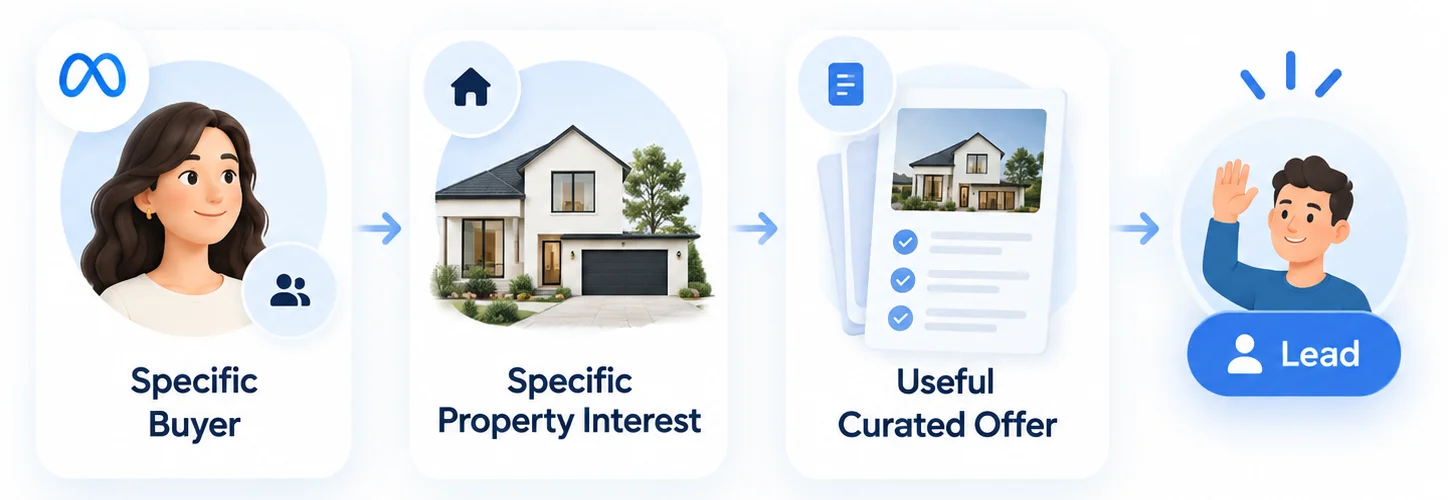
The campaign was not built around generic messaging such as "Looking to buy a home?"
It was built around a specific buyer, a specific interest, and a specific reason to respond.
Engage
Give the Prospect Something Worth Responding To
Once the audience and niche were clear, the next step was creating the offer.
The ads were built around giving the prospective buyer something useful in exchange for their contact information.
One of the strongest approaches was a curated property list related specifically to the niche.
Depending on the campaign, that could focus on things such as:
- coming-soon properties
- off-market opportunities
- new construction
- specific property types
- specific amenities
- highly filtered inventory
The point was not simply to ask someone to become a lead.
The offer gave them a useful reason to make a small commitment first.
Meta Lead Ads
Make the First Conversion Easy
The first conversion used Facebook and Instagram Lead Ads.
Instead of immediately asking the prospect to complete a long application, the initial form collected the basic information needed to begin the relationship:
- name
- phone number
- buying timeline
The objective was to reduce friction at the first conversion.
But the first form was not the end of the funnel.
Qualification
Ask for More After the First Commitment
After the initial opt-in, the thank-you experience became a bridge to a second step.
The prospect could answer additional questions through a longer, more conversational form.
This created two levels of information.
Step 1
Low-Friction Meta Lead Form
- Name
- Phone
- Buying timeline
Step 2
Deeper Qualification
- Needs
- Property preferences
- Situation
- Motivation
The original lead is retained even if the second form is not completed.
Historically, roughly 30 to 40 percent of initial leads completed the additional long-form questions.
The value of the process was that the remaining leads were not lost.
If someone stopped after the initial form, I still had their basic contact information.
The second step added qualification without forcing every prospect through a long form before they could convert.
Lead Intelligence
Collect Information That Makes the Conversation Better
The longer form was designed to uncover information that could actually help the agent have a stronger conversation.
Instead of simply asking for more contact information, the questions helped identify:
- needs
- preferences
- timeline
- situation
- motivation
- property criteria
The form used a question-by-question experience instead of presenting one long intimidating form.
That gave the agent more context before the sales conversation began.
Follow-Up
The Lead Submission Became the Beginning of the Process
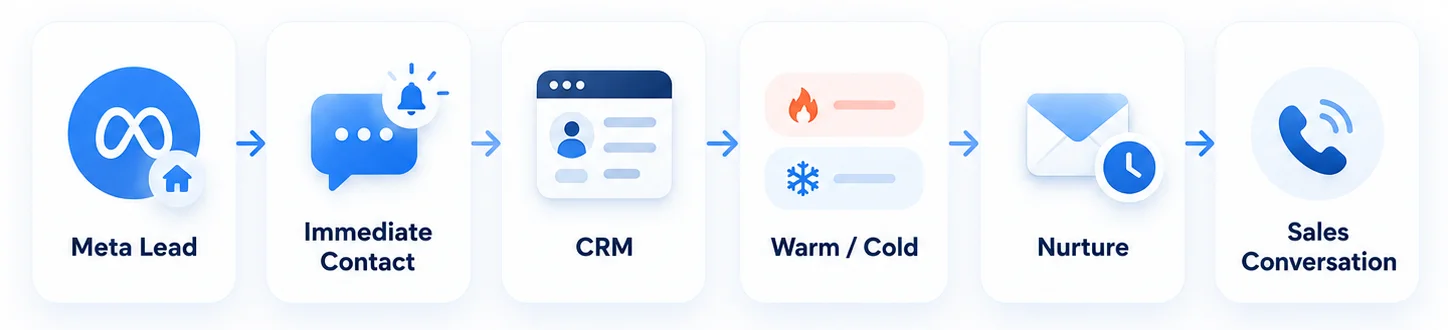
Once someone became a lead, the process moved into the CRM.
The objective was to make contact quickly while the original ad and offer were still fresh.
But I did not expect every Meta lead to be ready immediately.
The system separated immediate response from long-term relationship building.
CRM
Give Personal Attention to the Leads That Earn It
Warmer Prospects
- meaningful conversation
- stronger intent or engagement
- personalized follow-up
- priority attention from the agent
Colder Prospects
- not ready yet
- continued automated nurture
- retained in the database
- opportunity to re-engage later
The purpose of automation was not to replace the agent.
It was to prevent the agent from spending the same amount of personal time on every lead regardless of readiness.
Nurture
Stay Relevant Through a Long Real Estate Buying Cycle
Real estate has a long buying cycle.
Someone who responds to a Facebook or Instagram ad today may not purchase for months.
That made the database itself an important marketing asset.
- 1Immediate Response
- 2Welcome Sequence
- 3Ongoing Email
- 4Periodic Text / Call
- 5Buying Timeline Approaches
- 6Higher-Touch Follow-Up
The strategy was not to repeatedly ask, "Are you ready to buy yet?"
Useful and timely information gave the agent legitimate reasons to continue communicating.
As the prospect's expected buying timeline approached, follow-up could become more frequent and more personal.
Database Value
Older Leads Didn't Have to Stay Dead
The strategy also included reactivating older prospects.
Existing leads could be placed back into relevant nurture instead of requiring new ad spend to create every future opportunity from scratch.
Over time:
New ads generated new leads.
New leads grew the database.
The database created future opportunities.
That made the lead database increasingly useful as the system matured.
The Full System
From Market Research to Sales Conversation
- 1Market Research
- 2Specific Buyer Niche
- 3Meta Ad
- 4Valuable Offer
- 5Low-Friction Lead Form
- 6Progressive Qualification
- 7CRM
- 8Immediate Follow-Up
- 9Nurture
- 10Sales Conversation
- 11Client
Why Meta
Meta Could Create Demand Before Someone Searched for an Agent
Facebook and Instagram were particularly useful for this system because the platforms allowed me to put a relevant offer in front of prospective buyers before they necessarily went searching for a real estate agent.
The advertising created the first interaction.
The progressive funnel increased the amount of useful information available about stronger prospects.
The CRM and nurture system supported the longer buying cycle.
And the agent could focus more personal attention on the prospects who were actually engaging.
What Changed
From Facebook Leads to a Full Acquisition Process
Before
- Generic real estate advertising
- Broad buyer messaging
- Lead treated primarily as contact information
- Little distinction between cold and engaged prospects
- Heavy dependence on immediate follow-up
- Older leads easily forgotten
After
- Niche-specific Meta campaigns
- Offers built around buyer interests
- Low-friction initial conversion
- Progressive qualification
- CRM segmentation
- Immediate response
- Long-term nurture
- Database reactivation
- Clear path from lead to sales conversation
What This Project Reinforced
Four Things I Took Away From This System
1. Specificity Makes Advertising Stronger
The more clearly the marketing speaks to a particular buyer's situation, the easier it becomes to create an offer that feels relevant.
2. Don't Ask for Everything Up Front
The initial conversion can stay simple. Additional qualification can happen after someone makes the first commitment.
3. Lead Generation and Lead Conversion Are Different Problems
Advertising creates the opportunity. The system after the lead helps turn that opportunity into a conversation.
4. The Database Becomes More Valuable Over Time
Someone who is not ready today is not necessarily a bad lead. Consistent nurture gives the business another chance when the timing changes.
How I Market Real Estate Today
This Was a Meta-First System. My Approach Has Evolved Since Then.
This case study reflects the Meta-focused system I was using at the time.
Facebook and Instagram were the acquisition channels for this particular process.
Since then, I have developed a newer and more advanced Google Ads management methodology designed around capturing people who are already demonstrating active search intent.
That gives me two different ways to approach real estate lead generation today.
Meta
Create and nurture demand
- reach niche audiences
- introduce relevant offers
- build a lead database
- progressively qualify
- nurture over time
Capture active demand
- reach people already searching
- align campaigns with active intent
- build landing experiences around the search
- move high-intent prospects toward the next step
The right approach depends on the market, competition, budget, sales process, and where the strongest acquisition opportunity exists.
The principle behind both remains the same: don't optimize only for the lead. Build the system around what happens from the first interaction to the actual sales conversation.
See my full paid advertising and lead generation services.
Want More Than Just Real Estate Leads?
If you're running real estate ads but the process stops at the form submission, I can look at the whole acquisition path, from targeting and advertising to landing pages, qualification, CRM follow-up, nurture, and the eventual sales conversation.
You'll talk directly with me. No sales team and no pitch deck.