Local Retail Marketing Case Study
How I Turned Paid Ads Into a Repeatable In-Store Traffic System for a Minnesota Furniture Retailer
A Minnesota furniture retailer had been sending most paid traffic directly to its website. I rebuilt the strategy around a different objective: continuously bringing local shoppers into the store, staying in front of interested shoppers, and creating stronger demand around recurring sales events.

- Always-on paid acquisition
- Google + MetaAlways-on paid acquisition
- Two complementary campaign systems
- Evergreen + SalesTwo complementary campaign systems
- Past visitors, ad engagement and previous shoppers
- RetargetingPast visitors, ad engagement and previous shoppers
Certain client-specific financial and campaign details are withheld for confidentiality.
The Challenge
The Ads Were Driving Website Traffic, but That Wasn't the Real Business Goal
The retailer had already been working with another marketing provider, but most paid advertising was sending shoppers directly to the main website.
That could generate browsing activity, but it did not create a strong enough path from the ad to the showroom.
For a local furniture retailer, the website supports the buying process, but many customers still want to see furniture in person, compare materials, sit on a sofa, and walk through the store before making a purchase.
The marketing strategy needed to reflect how customers actually shop.
The objective was not simply to create more website sessions.
It was to get more local shoppers closer to an in-store purchase.
The Diagnosis
The Advertising Needed to Work Around the Customer Journey
Evergreen Local Traffic
The retailer needed campaigns that could run continuously instead of relying only on sales and promotions.
Search Intent
Google needed to capture people actively searching for furniture and related products in the local market.
New Customer Discovery
Meta needed a stronger way to reach people similar to the retailer's existing customers.
Retargeting
People who visited the website, interacted with ads, or had previously shopped with the store needed to continue seeing the retailer over time.
Product Visibility
The advertising platforms needed access to real product inventory instead of relying only on generic promotional creative.
Recurring Sales
Major sales needed dedicated ads, landing pages, reminders, and follow-up instead of simply sending promotional traffic to the main website.
The Strategy
I Rebuilt the Advertising Around Store Traffic
I treated the retailer's advertising as one connected system rather than a collection of disconnected campaigns.
The strategy combined always-on acquisition, product discovery, retargeting, and recurring promotional campaigns.
Evergreen flow
Always-on acquisition
- 1Google + Meta
- 2Evergreen Landing Page
- 3Product Discovery
- 4Retargeting
- 5Store Visit
Promotional flow
Recurring promotional campaigns
- 1Google + Meta Sale Ads
- 2Dedicated Sale Landing Page
- 3Reminder + Add to Calendar
- 4Retarget Interested Shoppers
- 5Sale Event / Store Visit
Conversion Experience
Evergreen Landing Pages Built to Encourage Store Visits
One of the biggest changes was creating dedicated evergreen landing pages instead of sending every visitor to the retailer's main website.
The main website still had an important role, but the landing pages were built around a more specific objective.
Get a local shopper interested enough to visit the store.
The pages gave the campaigns a focused destination where the messaging could match the ad and emphasize reasons to visit the showroom instead of encouraging endless online browsing.
These pages could stay active year-round, giving the retailer a consistent destination for ongoing paid advertising.
Google Ads
Capturing Active Local Search Demand
On Google, I targeted keywords around the products and shopping intent most relevant to the retailer.
That allowed the campaigns to reach people who were already looking for furniture rather than trying to create demand from scratch.
The ads and landing pages were aligned around those searches so the experience stayed consistent from the search result through the landing page.
Google became the channel for capturing active local demand.
Learn more about my Google Ads management.
Meta Ads
Using Existing Customers to Find More Local Shoppers
Facebook and Instagram served a different role.
Rather than relying only on broad demographic targeting, I uploaded the retailer's existing customer list and used it to build lookalike audiences.
That gave Meta a stronger starting signal for finding new people who shared characteristics with customers who had already purchased from the business.
These campaigns could introduce the retailer to potential customers who may not have been actively searching for furniture at that exact moment.
Google helped capture existing intent.
Meta helped expand demand.
See all of my paid advertising services, including Meta advertising.
Google: Capture Active Local Demand
Reach local shoppers already searching for furniture and send them to landing pages that match what they searched for.
Meta: Expand and Re-Engage the Audience
Use existing customers to find similar local shoppers, then keep the store in front of people who have already engaged.
Google captures existing intent. Meta helps expand demand and stay top of mind.
Retargeting
Once Someone Discovered the Store, I Kept the Brand in Front of Them
The strategy did not stop after someone clicked an ad or visited the website.
I built retargeting audiences around people who had:
- interacted with the retailer's ads
- visited the website or landing pages
- engaged with the business on Facebook or Instagram
- previously purchased from the store
- entered the retailer's existing customer database
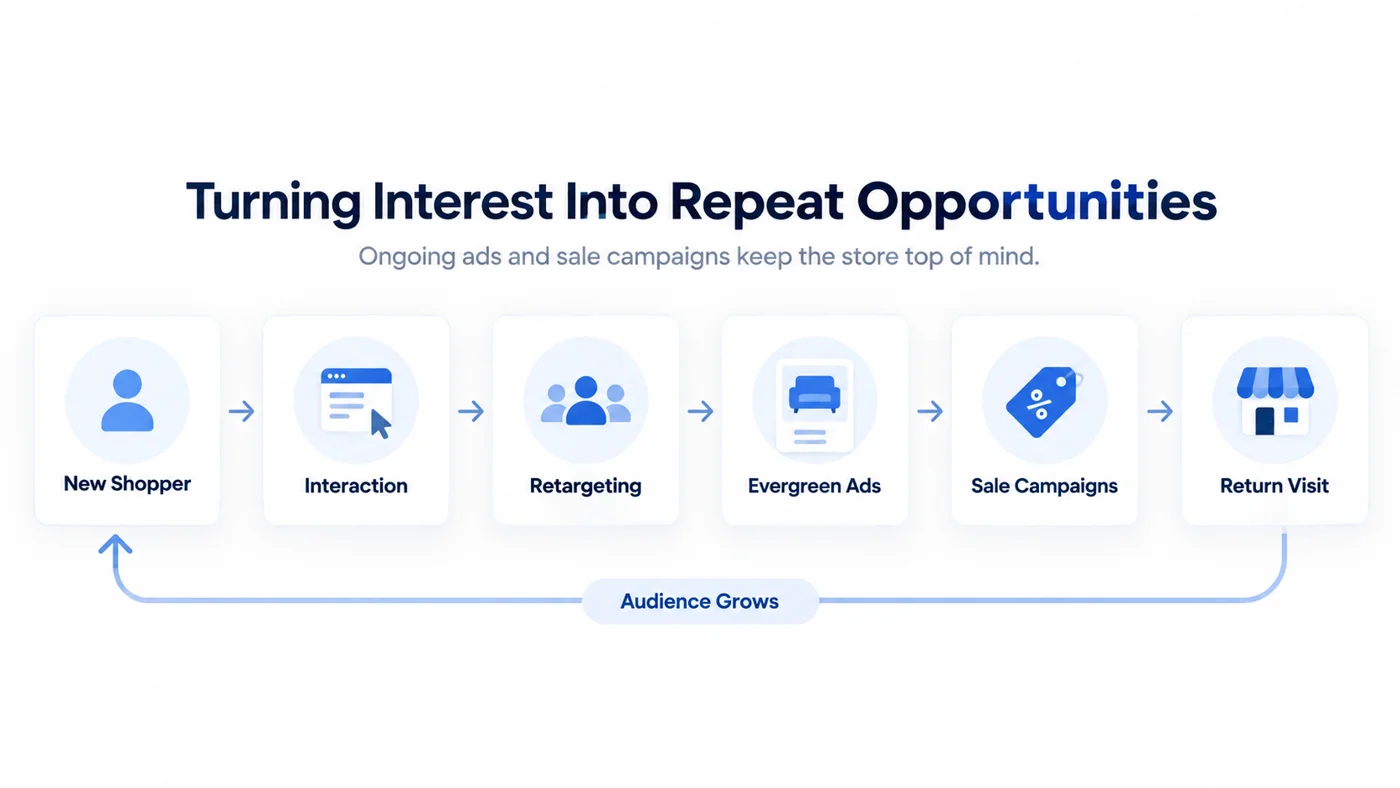
These audiences became part of the evergreen advertising strategy.
Furniture purchases often happen over days or weeks.
Someone may browse today, compare options, think about a purchase, and come back later.
Instead of paying to introduce the business once and then disappearing, the advertising system was designed to continue showing up in front of interested shoppers.
The goal was simple:
Once someone discovers the store, do not make them rediscover it from scratch.
Keep the retailer visible and top of mind until the timing is right for that shopper to act.
Product Advertising
Bringing the Retailer's Product Catalog Into Google and Meta
I connected the retailer's product catalog to both Google and Meta.
This gave the advertising platforms access to actual merchandise instead of relying only on generic promotional creative.
Products could become part of the advertising experience, helping shoppers see the kinds of furniture available before deciding whether to visit the store.
The catalog also created a stronger foundation for dynamic and product-focused advertising across both platforms.
Promotional Campaigns
Building a Separate Acquisition System Around Major Sales
The retailer regularly runs larger sales approximately every month or every other month.
Rather than simply changing the evergreen ads or sending promotional traffic to the homepage, I created dedicated campaigns and landing pages for those events.
Each sale could have its own:
- messaging
- creative
- Google campaigns
- Meta campaigns
- landing page
- promotional details
- call to action
- reminder functionality
- calendar functionality
This gave each event a focused conversion path and made it possible to build demand specifically around the promotion.
These sale campaigns have become an important part of the retailer's advertising strategy and have driven significant revenue during promotional periods.
Audience Compounding
Every New Sale Could Start With an Audience That Already Knew the Store
One of the biggest advantages of the new system was that each promotional campaign did not have to start from zero.
For new sale campaigns, I could retarget people who had already:
- visited the website
- interacted with previous ads
- engaged with the business on social media
- visited previous sale landing pages
- purchased from the retailer in the past
That meant every new promotion could reach both new shoppers and people who were already familiar with the store.
Someone who discovered the retailer through an evergreen campaign could later see an ad for the next sale.
Someone who interacted with one sale but did not purchase could continue seeing the evergreen advertising and then be brought back into future sale campaigns.
Over time, the retailer built a growing audience of people who already recognized the business.
- 1Evergreen Campaigns
- 2New Visitors
- 3Retargeting Audience
- 4Sale Campaign
- 5New Engagement
- 6Larger Retargeting Audience
- 7Next Sale
Sale Experience
Giving Shoppers a Way to Remember the Sale
A shopper may see an ad several days before a sale but forget about it by the time the event starts.
So the sale landing pages included calls to action that allowed visitors to:
Get reminded about the sale
and
Add the sale to their calendar
This created another step between seeing the ad and showing up at the store.
Instead of relying entirely on someone remembering a Facebook ad or Google search, the landing page could help bring the event into their personal schedule.
Sale Reminder
A way for interested shoppers to get reminded before the event.
Add to Calendar
A way to put the sale directly onto their schedule.
The Result
An Always-On Retail Acquisition System With Promotional Surges
The retailer now has three complementary parts of its acquisition strategy working together.
Evergreen Advertising
Google and Meta campaigns run continuously to keep the retailer visible to local shoppers and create ongoing opportunities to bring people into the store.
Persistent Retargeting
Website visitors, ad engagement, social engagement, and past shoppers can continue seeing the retailer over time instead of disappearing after a single interaction.
Product Catalog Advertising
Real inventory connected to Google and Meta lets shoppers see the kinds of furniture available before deciding to visit the store.
Sale Campaigns
Dedicated campaigns and landing pages create concentrated demand around major promotional events while using the audiences built through previous advertising.
The advertising system now follows a more realistic retail customer journey:
- 1Discover the retailer
- 2Browse products
- 3Continue seeing the brand
- 4See an upcoming sale
- 5Get reminded
- 6Visit the store
The objective is not simply more traffic.
It is keeping the retailer visible throughout the consideration process and creating repeated opportunities for an in-store visit.
What Changed
From Website Traffic to a Repeatable Local Retail System
Before
- Paid traffic primarily sent to the main website
- Website browsing used as the primary advertising destination
- Limited separation between everyday advertising and major sales
- Less use of existing customer data for prospecting
- Limited ongoing advertising to previous visitors
- Each campaign depended more heavily on finding new traffic
- General promotional messaging
- Shoppers responsible for remembering future sales
After
- Evergreen landing pages focused on store visits
- Google campaigns built around local search intent
- Meta lookalike audiences based on existing customers
- Website and ad-engagement retargeting
- Past shoppers included in ongoing advertising audiences
- Product catalogs connected to Google and Meta
- Always-on advertising alongside promotional campaigns
- Dedicated landing pages for recurring sales
- Every new sale can retarget existing audiences
- Sale reminder functionality
- Add-to-calendar functionality
- A growing audience that can be marketed to repeatedly
What This Project Reinforced
Four Things I Took Away From This Project
Website Traffic Is Not Always the Real Goal
For a local retailer, more website sessions do not automatically mean better marketing. The strategy should reflect what the business ultimately needs customers to do.
The First Click Shouldn't Be the Last Interaction
Furniture purchases can have a longer consideration period. Retargeting gives the retailer a way to remain visible after the first interaction.
Google and Meta Can Play Different Roles
Google helps capture people already searching. Meta helps introduce the retailer to additional shoppers and expand the audience.
Every Campaign Can Make the Next One Stronger
Evergreen campaigns create audiences for future sales. Sale campaigns create audiences that can be reused in future evergreen advertising and future promotions.
The System
The Goal Was Never Just to Run Google Ads or Facebook Ads
The goal was to build an advertising system around how customers actually shop for furniture.
Evergreen campaigns keep the store visible throughout the year.
Product advertising helps shoppers discover inventory.
Google captures people already searching.
Meta expands the audience.
Retargeting keeps the retailer visible after the first interaction.
Existing customers stay connected to future promotions.
Dedicated sale campaigns create promotional spikes.
Sale reminders and calendar tools help turn interest into attendance.
And the landing pages give shoppers a clearer reason and path to visit the store.
The result is a repeatable local retail acquisition system that becomes more useful as more shoppers interact with it.
Want Your Ads to Drive More Than Website Traffic?
If your business depends on local customers actually showing up, I can look beyond clicks and website traffic. We'll look at the ads, landing pages, audience strategy, retargeting, and what needs to happen after someone discovers your business.
You'll talk directly with me. No sales team and no pitch deck.